
Why cut some of the ladder ties in the stage legs of the manual microscope?
The Microscope stage uses a system of parallelograms to move smoothly. In the stage legs, the parallelogram is formed by stiff bars at the sides and at the top and bottom, which are connected by four thin flexure hinges in the corners.
There are also ladder ties bridging between the stiff vertical side bars at intervals which help to stabilise printing. Most of these horizontal ties are the same length as the top and bottom of the leg (the top bar plus the flexure joint), so they form multiple smaller equivalent parallelograms, which do not affect the motion of the main leg structure.
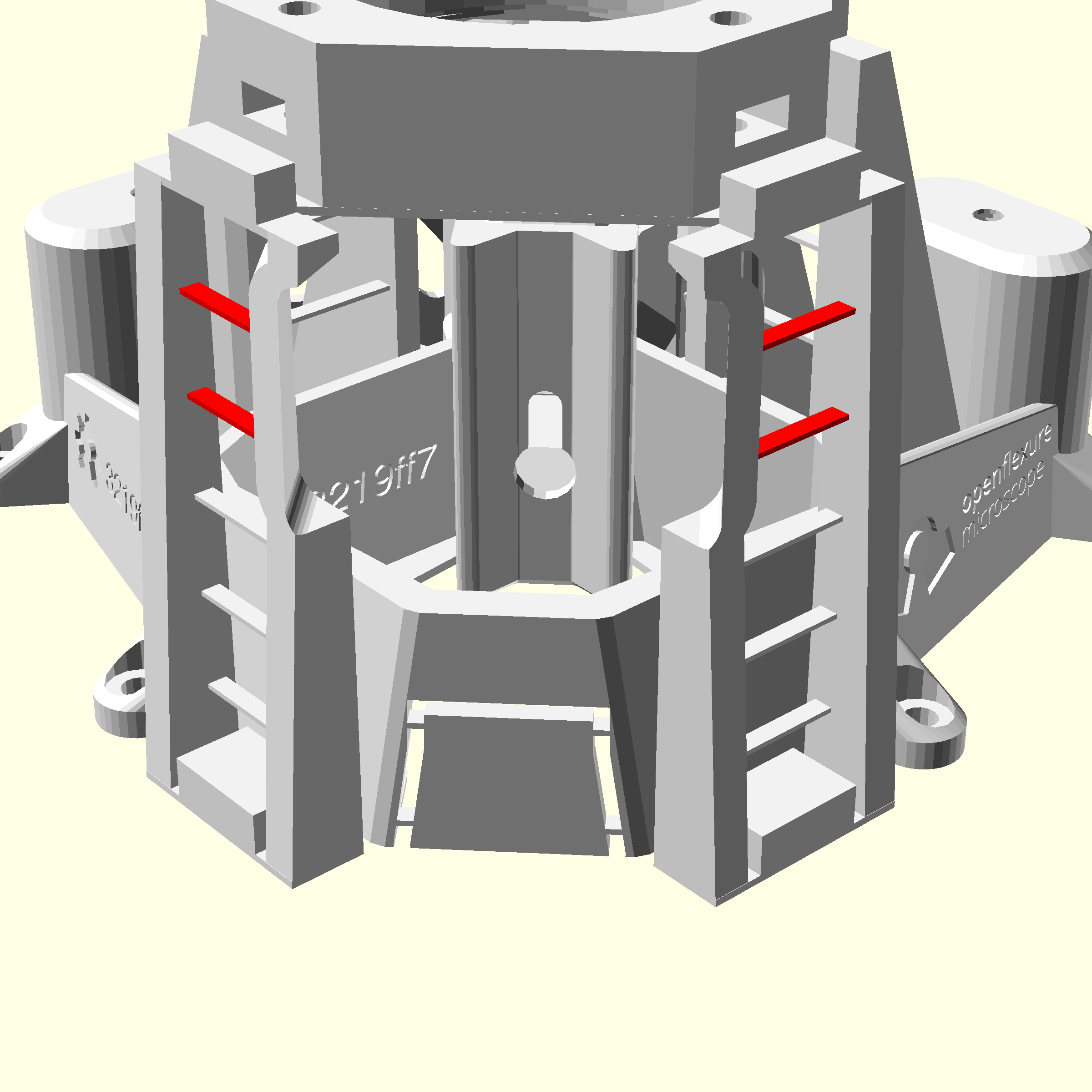
For the Manual Microscope the vertical side bars of the legs are bowed to give space for the camera module. This does not affect the geometry of the motion because the four flexure hinges remain at the corners of a parallelogram. However some of the ladder ties are now shorter and do not form equivalent parallelograms, so they need to be cut to avoid putting stress on the structure.